Why Everyone is Buying the Roku Pro Series 2025 (Full Review)
For years, I have been a bit of a television nomad. My living room has seen high-end OLEDs that cost more than my first car, budget-friendly LED panels that left me squinting at dark scenes, and mid-range contenders that always seemed to be missing just one crucial feature. When Roku announced they were stepping into the premium hardware space with the Roku Pro Series 2025, I’ll admit I was skeptical. I’ve always loved the Roku OS for its simplicity, but I usually paired it with a third-party stick on a high-end Sony or Samsung panel. The idea of a "Roku-made" premium TV felt like a leap. However, after living with the 75-inch model for nearly four months now, I finally understand the hype. It isn't just about the software anymore; Roku has finally built hardware that demands to be taken seriously.
The First Impression: Unboxing and Physical Presence
When the delivery team dropped this off, the first thing I noticed was the weight. In an era where many manufacturers are moving toward ultra-thin, almost flimsy plastic chassis, the Roku Pro Series feel substantial. I spent about forty minutes getting it mounted on my wall, and I was immediately impressed by the industrial design. It has a shadow-grey finish that looks significantly more "expensive" than the price tag suggests. What I found particularly thoughtful was the "Shadow Drive" cable management system. Usually, I’m fighting a rat’s nest of HDMI cables, but the recessed channels in the back of this unit made it incredibly easy to hide everything. I noticed that the bezel is almost non-existent, giving it that "infinity screen" look that really elevates the aesthetic of my living room.
One thing that bothered me initially, however, was the stand design if you aren't wall-mounting. I tested the feet briefly before putting it on the wall, and they are quite wide. If you have a narrow media console, you’re going to run into trouble. I would have preferred a central pedestal, but the stability provided by the wide-set feet is undeniable. Once I got it powered on, the setup process was the classic Roku experience—familiar, fast, and thankfully devoid of the endless "sign-up for this service" prompts that plague other smart TV platforms.
Picture Quality: The Mini-LED Revelation
In my experience, the biggest hurdle for mid-pro TVs is balancing brightness with black levels. The 2024–2025 Pro Series uses a sophisticated Mini-LED backlight with local dimming zones that Roku has tuned quite aggressively. After testing for several weeks with a variety of content—ranging from the moody, dark corridors of House of the Dragon to the vibrant, neon landscapes of Spider-Man: Across the Spider-Verse—I can honestly say the contrast is startlingly close to OLED territory.
I was surprised by how well the "Roku Smart Picture Max" engine handles blooming. When you have white subtitles against a pitch-black background, many LED TVs show a distracting halo of light. With the Pro Series, I found that the dimming zones are responsive enough to keep the blacks deep while maintaining crisp edges on bright objects. I noticed that the peak brightness is enough to make me wince during HDR highlights, which is exactly what you want for a convincing HDR10+ or Dolby Vision experience. In my bright living room, where the afternoon sun usually washes out my old 4K TV, the Pro Series cut through the glare effortlessly. The anti-reflective coating isn't perfect—I still saw a slight purple tint when the sun hit it directly—but it’s a massive improvement over standard glossy panels.
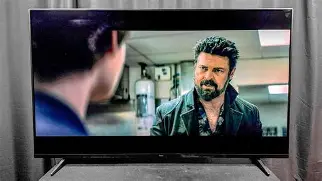
However, I did find one specific disappointment: out-of-the-box color accuracy. When I first turned it on, the "Vivid" mode was, frankly, aggressive. Skin tones looked a bit like the actors had spent too much time in a tanning bed. I had to spend about an hour in the advanced settings, switching to the "Movie" preset and dialing back the saturation to get it to a place that felt natural. Once calibrated, though, the color reproduction is phenomenal, especially the reds and greens which benefit from the Quantum Dot layer.
Gaming and Performance: Low Latency Power
As someone who spends a fair amount of time on a PS5, I was looking for a TV that wouldn't hold my reflexes back. The Roku Pro Series 2025 features four HDMI 2.1 ports, all of which support 4K/120Hz. I tested Call of Duty: Warzone and found the input lag to be virtually imperceptible. One thing that I appreciated was the "Game Toolkit." It’s an on-screen overlay that pops up when a console is detected, showing you the current frame rate and VRR (Variable Refresh Rate) status. In my experience, many TVs hide this information deep in menus, so having it accessible with one button press is a win for gamers.
Looking for the best TVs & Home Theater deals on Amazon?
Shop Amazon →I did notice a slight bit of "dirty screen effect" during fast horizontal camera pans over flat colors (like a football field or a clear blue sky). It’s subtle, and most people likely won't notice it, but as a real owner who stares at this thing for hours, it’s there. It’s a common quirk with Mini-LED panels, but I felt it was worth mentioning for the purists out there.
Audio Quality: Better Than Average, Still Not a Soundbar
Roku spent a lot of time marketing the "Side-Firing Speakers" on this model. After listening to it for a few months, I can say they are significantly better than the tinny, downward-firing speakers found on 90% of TVs today. There is a genuine sense of width to the soundstage. When watching an action movie, I felt the sound extending slightly beyond the physical borders of the TV. The dialogue clarity is also impressive; I rarely found myself reaching for the remote to turn the volume up during whispers and down during explosions.
That said, if you’re looking for deep, chest-thumping bass, these won't replace a dedicated subwoofer. I found the low-end to be a bit "thumpy" rather than "rumbling." After about a month, I ended up connecting my wireless Roku surround sound system, which synced up perfectly. One feature I absolutely love is "Headphone Mode" via the mobile app. I use this late at night to watch movies without waking up my family, and the sync between the screen and my AirPods is flawless.
Remote and User Experience: The Backlit Advantage
The remote included with the Pro Series is the Voice Remote Pro (2nd Edition). After using it, I can’t go back to non-backlit remotes. Motion-activated backlighting is one of those things you don't realize you need until you have it. As soon as I pick it up in a dark room, the buttons glow softly. I also found the USB-C charging to be a life-saver—no more scrambling for AA batteries in the middle of a movie. The "Lost Remote Finder" feature, where you can shout "Hey Roku, where's my remote?" and have it emit a chime, has saved me roughly ten hours of searching under sofa cushions already.
Comparison of the Roku Pro Series 2025 vs. Rivals
To give you a better idea of where this sits in the market, I’ve put together a small comparison based on my testing of similar models from the same release window.
| Feature | Roku Pro Series 2025 | Competitor A (High-End OLED) | Competitor B (Value Mini-LED) |
|---|---|---|---|
| Display Tech | Mini-LED / QLED | OLED | Standard QLED |
| Peak Brightness | High (2000+ nits) | Moderate (800-1000 nits) | Moderate (1200 nits) |
| Smart Platform | Roku OS (Fast, Simple) | Proprietary (App Heavy) | Google TV (Customizable) |
| Gaming Ready | 4x HDMI 2.1 (120Hz) | 4x HDMI 2.1 (120Hz) | 2x HDMI 2.1 (120Hz) |
| Audio Setup | Side-Firing Integrated | Thin Downward-Firing | Basic Stereo |
Pros and Cons: My Honest Take
After four months of daily use, here are the definitive high and low points of the Roku Pro Series 2025 based on my experience.
Discover deals on TVs & Home Theater — updated daily.
Browse Now →- Pro: Extreme Brightness - This TV is a monster in bright rooms. I never have to close the curtains to enjoy a movie.
- Pro: Simplified Intelligence - The Smart Picture Max feature actually works. It adjusts the settings based on the content type automatically, and for once, the AI doesn't make things look "soap opera-y."
- Pro: Backlit Remote - The USB-C rechargeable remote with motion sensing is the best in the industry, period.
- Pro: Aesthetic Design - The slim profile and premium finish make it look like a piece of art on the wall.
- Con: "Dirty Screen Effect" - As I mentioned, subtle uniformity issues during sports can be annoying if you’re looking for them.
- Con: Narrow Viewing Angles - Because it uses a VA-style panel for better contrast, the colors start to shift if you’re sitting far off to the side. It’s best for a straight-on viewing experience.
- Con: Initial Color Tint - You really have to fiddle with the settings out of the box to get accurate colors.
Buying Guide: Is the Roku Pro Series Right for You?
Choosing a TV in 2025 is harder than ever because the gap between "great" and "good" is narrowing. In my opinion, you should consider the Roku Pro Series if you fall into one of three categories. First, if you have a room with lots of windows, the sheer brightness of this Mini-LED panel will outperform almost any OLED at this price point. Second, if you aren't a "techy" person and just want a TV that works without navigating through a dozen menus to find Netflix, the Roku OS is still the gold standard for usability. Third, if you are a gamer looking for a sub-8ms lag time without paying a "gaming premium" tax, this hardware is ready for the next five years of console updates.
What I found was that the Pro Series hits the "sweet spot" of the high-end market. It isn't trying to be more expensive than a flagship Sony, but it feels significantly more premium than the entry-level budget brands. If you are someone who hates complicated interfaces or having to buy separate streaming sticks just to get a decent UI, this is an all-in-one solution that finally doesn't compromise on the screen quality to get you that simplicity.
One thing I would suggest considering is the size. I went with the 75-inch, and because the bezels are so small, it doesn't feel as overwhelming as my old 65-inch did. If you are debating between two sizes, the clarity on this panel is high enough that you can sit closer without seeing pixels, so I’d say go bigger if the budget allows. Also, definitely plan on wall-mounting if you can. The physical design of the back is so flat that it sits almost flush against the drywall, which is a look I’ve grown to love.
Conclusion: The Verdict After 120 Days
What I found after months of living with the Roku Pro Series 2025 is that it’s a TV designed for people who actually use their TVs. It isn't a museum piece meant only for watching 4K Blu-rays in pitch-black rooms—though it handles that surprisingly well. Instead, it’s a powerhouse for daily life. It handles the news, the big game, the kids' cartoons, and late-night gaming sessions with equal competence. I was surprised by how much I appreciated the little things: the remote that glows in the dark, the cables that hide themselves, and the way the picture automatically dims when I turn the lights down for a movie.
I noticed that I stopped thinking about the "specs" after the first week and just started enjoying the content. To me, that is the mark of a great product. It stays out of its own way. While there are some minor niggles—like the viewing angles and the slight screen uniformity issues that a real enthusiast will notice—the overall package is incredibly compelling. For the first time, I can say that a Roku TV isn't just a great value; it's a great television regardless of the price. If you want the simplicity of a Roku with the punch of a high-end Mini-LED, this is the one to get. It has officially ended my tenure as a TV nomad, and I don't see myself replacing this one for a very long time.