Which is Better Value? Innocn 27 Ga27W1Q 4K Monitor vs Nvidia In 2025 Year In Compared
Introduction
When choosing where to spend a limited budget in 2025, buyers often face a practical trade-off: upgrade the display or upgrade the graphics stack that drives it. The Innocn 27 Ga27W1Q 4K monitor (a contemporary 27" 4K offering aimed at creators and gamers) represents a straightforward hardware investment: a sharper, larger, and more color-accurate workspace. On the other side, "Nvidia in 2025" stands for the platform-level improvements and GPU upgrades that Nvidia has pushed into the market in recent years—higher rendering performance, AI-driven upscaling and frame generation, and driver features that can transform how a display feels in games and creative apps.
This article sits squarely in the Laptops category but is written for anyone deciding between prioritizing a modern 4K monitor or investing in Nvidia's GPU technologie(s) and ecosystem in 2025. It breaks down real-world use cases, priorities buyers typically care about, detailed analysis of each option, a side-by-side comparison table, a buying guide, and a balanced conclusion that helps readers choose the best value for their situation.
What buyers typically care about
- Image quality: resolution, color accuracy, dynamic range (HDR), and perceived sharpness for the screen size.
- Responsiveness: refresh rate, input lag, and how the GPU/display pair feel in motion for gaming.
- Compatibility: ports, laptop docking, adaptive-sync (G-SYNC/FreeSync), and whether existing hardware can take advantage of a new screen.
- Future-proofing and longevity: whether a purchase will remain useful over multiple upgrade cycles.
- Price-to-performance: the real-world benefit per dollar — e.g., is that extra sharpness or frame-generation more valuable than raw frame rate?
- Workflow impact for creators: color gamut, calibration, pixel density, and connectivity with cameras and laptops.
Product analysis: Innocn 27 Ga27W1Q 4K Monitor
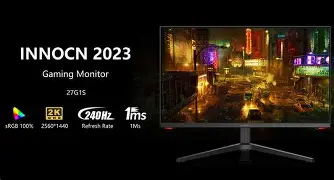
The Innocn 27 Ga27W1Q is positioned as a 27-inch 4K monitor that targets buyers who want high pixel density without moving up to very large screens. For laptop users who dock at a desk or creators who want a compact, sharp canvas, a 27" 4K panel hits a sweet spot: text and UI elements gain clarity, and photo/video timelines show more detail without excessive scaling complications.
Strengths of putting budget into the Innocn monitor:
- Immediate visual upgrade. A native 4K panel on a 27" display provides significant improvements to text clarity and image detail compared with 1080p or 1440p screens.
- Better color and contrast for content creation. Many monitors in this class emphasize wide color gamuts and factory calibration, which is valuable for photo and video work where screen fidelity matters.
- Improved productivity. More usable screen real estate at native resolution means more windows visible simultaneously—useful for code, spreadsheets, or multi-app workflows on a laptop.
- Docking-friendly. Modern 4K monitors often include USB-C with display and power delivery, making them attractive companions for laptops.
Limitations to be realistic about:
- GPU-limited benefits for gaming. A 4K monitor exposes limitations of mid-range laptop GPUs; without a powerful desktop or high-end mobile GPU, many games will not run at native 4K at high refresh rates.
- Refresh rate trade-offs. Some 27" 4K panels prioritize color and HDR over ultra-high refresh rates. If a specific Innocn model targets creators, refresh rates may be 60–144Hz depending on configuration; buyers must verify the exact spec.
- Value depends on what’s already owned. If a user’s laptop or GPU cannot feed 4K at usable refresh, the monitor can feel underutilized until a GPU upgrade happens.
Pros & Cons — Innocn 27 Ga27W1Q 4K Monitor
- Pros:
- High pixel density for crisp text and detailed images
- Likely accurate colors and calibration options for creators
- Good dockability and desktop ergonomics for laptop users
- Cons:
- Full benefit requires a capable GPU
- Potentially lower refresh rates compared with gaming-focused monitors
- Value depends on long-term use; doubled benefit only if used daily for productivity or creation
Product analysis: Nvidia in 2025 (GPU & ecosystem upgrades)
In this article "Nvidia in 2025" refers to the value of investing in Nvidia's GPU ecosystem: upgrading a laptop/desktop GPU, or prioritizing a system that benefits from Nvidia’s software features in 2025. Nvidia's platform focus over recent years has been performance-per-watt gains, ray tracing where applicable, and significant software-driven image improvements like AI upscaling and frame generation. These changes shift the value equation: rather than buying a higher‑resolution display and struggling for native performance, a GPU upgrade (or choosing an Nvidia-equipped laptop) can make an existing monitor feel much smoother and more capable.
Discover deals on Laptops & Computers — updated daily.
Browse Now →Key benefits of prioritizing Nvidia:

- Software-driven performance gains. Technologies such as AI upscaling and frame generation improve perceived smoothness and can increase effective frame rates without pushing native pixel counts.
- Better utilization of high-resolution displays. A stronger GPU means games and creative GPU-accelerated apps actually operate at higher fidelity at 4K.
- Adaptive-sync and driver stability. Nvidia's drivers and G-SYNC compatibility improve responsiveness and reduce tearing across a variety of panels.
- Broader ecosystem features. From accelerated encoding/decoding for video workflows to dedicated AI cores used by some creative applications, the GPU upgrade can accelerate a user's entire workflow.
Limitations and considerations of a GPU-centric purchase:
- High cost, especially for laptops. Upgrading a laptop GPU is often impossible; choosing a machine with a flagship mobile GPU significantly raises the price.
- Diminishing returns for certain users. If primary tasks are email, web, and office apps, a GPU upgrade offers minimal practical benefit compared with a display upgrade.
- Compatibility and thermals. Powerful GPUs can require larger chassis and better cooling, which impacts battery life and portability on laptops.
Pros & Cons — Investing in Nvidia (2025 platform)
- Pros:
- Transforms gaming on existing displays through higher effective frame rates and frame generation
- Accelerates GPU-heavy creative workloads and encoding
- Enables use of advanced features (ray tracing, AI upscaling) that lift visual fidelity
- Cons:
- Higher upfront cost, especially if replacing a laptop
- Some benefits require compatible software and drivers
- Does not improve physical ergonomics or native pixel density of a screen
Side-by-side comparison
| Category | Innocn 27 Ga27W1Q 4K Monitor | Nvidia (2025 GPU & ecosystem) |
|---|---|---|
| Primary benefit | Improved pixel density, color fidelity, and workspace ergonomics | Higher render performance and AI-driven image/frame improvements |
| Best for | Content creators, productivity users, laptop dockers who want a sharper desktop | Gamers chasing smoothness at high fidelity; creators who need hardware acceleration |
| Cost profile | One-time display purchase; mid-range cost relative to GPUs | Often higher total cost (especially laptops or desktop GPU upgrades) |
| Immediate impact | Instant visual improvement for daily tasks and content work | Depends on current hardware; can be transformative if the GPU was the bottleneck |
| Dependency | Works regardless of GPU, but peak value needs capable GPU | Requires compatible display to realize full benefits (resolution/refresh) |
| Future-proofing | Moderate — the display will last many years if well chosen | High performance uplift now but fast-moving GPU cycles may make latest hardware age sooner |
Real-world use cases and recommendations
1. The laptop-first content creator (photo, video editing, color work)
For a creator who primarily works on a laptop and docks at home, a 4K 27" monitor often provides the largest productivity and fidelity gains per dollar. Timelines become easier to read, previews are sharper, and a properly calibrated panel improves color decisions. Unless the creator also renders complex GPU-accelerated effects daily and their current GPU is painfully slow, the Innocn monitor usually provides more immediate value.
2. The gamer who wants both high fidelity and high frame rates
Gamers face a split choice: native 4K at high refresh is very demanding. Investing in Nvidia hardware that supports AI upscaling and frame generation can give the sensation of higher frame rates on an existing monitor without the cost of a top-tier GPU that can push native 4K at 144Hz. For gamers who can’t afford both a powerful GPU and a 4K high‑refresh screen, prioritizing the GPU (Nvidia in 2025) usually yields a better feeling of responsiveness and smoother gameplay.
3. The hybrid user — productivity by day, gaming by night
Hybrid users should balance the two. If the laptop already sports a mid-range GPU, buying a 4K monitor improves daily work. If gaming is valued most and the laptop is older or underpowered for modern titles, investing in a newer Nvidia GPU or a gaming laptop with a modern Nvidia mobile GPU may be the better path.
Find top-rated Laptops & Computers products at great prices.
See Deals →4. The traveler or mobile-first buyer
For someone who needs portability above all, upgrading the GPU is often impractical; buying a lighter, more capable laptop with Nvidia hardware can be expensive. A compact external 4K monitor can be bulky and defeats portability. In this case, choose the laptop/GPU that best fits mobility needs and delay a desktop monitor purchase.
Buying guide — how to decide which gives more value
Use the following checklist to decide between the Innocn 27 Ga27W1Q and investing in Nvidia (or both, staged over time):
- Assess current bottlenecks: If most apps and games feel sluggish, the GPU is the limiting factor. If image detail and screen real estate are the pain points, the monitor is the better investment.
- Match work to hardware: Photo, video, design and multitasking benefit immediately from a sharper, more color-accurate monitor. Real-time 3D, gaming, and GPU rendering benefit from a GPU upgrade.
- Check connectivity: Confirm laptop/desktop can connect via DisplayPort or HDMI at the desired resolution/refresh. If a laptop only supports older HDMI, the monitor may not reach its full specification without adapters or docks.
- Budget split strategy: If funds are limited, prioritize the component that removes the largest daily friction point. Many buyers get the best immediate ROI by upgrading the single element that most degrades their daily experience.
- Think long term: Monitors often last longer than a single GPU generation. If the priority is longevity and improved everyday productivity, a quality 4K monitor is a defensible long-term buy.
- Consider staged upgrades: Buy the monitor now and plan a GPU upgrade later (or vice versa). A 4K monitor will still be useful after a GPU upgrade, and an upgraded GPU will make an existing monitor feel more capable.
Practical tips before buying
- Read the exact spec sheet for the Innocn GA27W1Q model to confirm panel type, refresh rate, HDR support, and available ports (USB-C with PD is very useful for laptop setups).
- If planning to rely on AI-upscaling or frame generation, verify software compatibility on the titles and creative apps used most often.
- Check whether the laptop or desktop can output 4K at the refresh rate desired; older ports or integrated GPUs may limit signal options.
- Test ergonomics: 27” at native 4K can make UI elements small; confirm OS scaling behavior with the intended laptop before committing.
- Set realistic expectations: a good monitor improves clarity and color; a good GPU improves motion and rendering. The best experience is usually both combined, but budget constraints force prioritization.
Conclusion
Neither option is categorically superior for every buyer. The Innocn 27 Ga27W1Q 4K monitor is a strong value proposition for anyone who prioritizes sharper text, more detailed image editing, and improved productivity at their desk. Investing in Nvidia's 2025 GPU ecosystem is the better value for gamers and creators who rely on real-time rendering, hardware acceleration, and AI-driven frame improvements.
Practical advice: if daily productivity and color fidelity are the main goals, choose the monitor. If the primary pain point is low frame rates or slow GPU-accelerated tasks, prioritize Nvidia hardware or a system that leverages its 2025 software advances. For many users, the ideal path is staged: acquire the monitor to improve everyday work, then upgrade the GPU when budget and needs align, realizing the greatest long-term value when both elements complement each other.