Is the Asus Rp Ax58 Still Good in 2026? Long-Term Review
When I first bought the Asus RP-AX58, I was trying to solve a frustrating problem in my home: great Wi-Fi near the router, weak and inconsistent signal everywhere else. I had one room that always seemed to sit right on the edge of usable coverage, and another area where video calls would randomly drop quality even though my internet plan itself was fast. After living with the RP-AX58 for several months, I’ve come away with a much clearer view of what it does well, where it feels dated in 2026, and who it still makes sense for.
The short version is this: yes, the Asus RP-AX58 can still be good in 2026, but only in the right setup. In my experience, it remains a solid Wi-Fi 6 range extender for people who already have an Asus-friendly network environment or who simply want a practical way to improve coverage without replacing everything. But I also found that it is no longer the most exciting option if you are starting from scratch, especially now that mesh systems and newer standards have become more common.
What I appreciated most was how much it improved weak-signal zones once I found the right placement. What bothered me most was that it demanded more trial and error than I wanted, and its performance could swing noticeably depending on distance, wall thickness, and whether I used it as a straightforward extender or as part of a broader Asus setup.
My Experience Using the Asus RP-AX58 Over Time
I’ve been using this for long enough to get past the “new gadget optimism” stage. That matters, because devices like this usually make a strong first impression. You plug them in, see a coverage boost in a dead zone, and assume the problem is solved. The real test comes later, when you’ve used it through normal workdays, streaming sessions, smart home routines, firmware updates, and the occasional weird network hiccup.
In my case, the RP-AX58 ended up in a hallway roughly halfway between my main router and the weakest part of the home. I tested it first too far away from the router, and performance was disappointing. Speeds were better than the weak zone had been before, but not stable enough to feel like a true fix. Once I moved it closer to the router, I noticed a much more reliable connection, even if the raw speed number wasn’t always spectacular. That became one of my biggest takeaways: placement matters more than most people expect.
After testing for several months, I found the RP-AX58 to be strongest in these scenarios:
- Extending coverage to bedrooms, offices, or corners of a home that have usable but weak signal
- Helping phones, tablets, laptops, and smart TVs hold onto Wi-Fi more reliably
- Providing a simpler upgrade path when I didn’t want to replace my main router
Where it felt less impressive was in situations where I expected it to perform like a premium whole-home mesh system. It can improve reach, but it doesn’t magically eliminate every Wi-Fi limitation. If the incoming signal to the extender is mediocre, the output experience will also be mediocre. That sounds obvious, but it is the central truth of long-term use with products like this.
Design, Build, and Daily Practicality
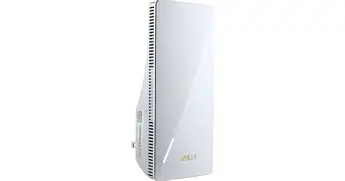
The RP-AX58 has the kind of design that fits Asus networking gear: practical, slightly technical-looking, and more focused on function than elegance. I wouldn’t call it ugly, but I also wouldn’t call it subtle. In my home, it looked acceptable in a hallway outlet, though I was always aware of it rather than forgetting it was there.
One thing I liked was that it felt like a serious piece of hardware rather than a flimsy budget extender. It never gave me the impression of being cheaply made. It also stayed fairly dependable in day-to-day operation. I didn’t have to constantly reboot it, which is one of the easiest ways for a networking product to lose my trust.
That said, one thing that bothered me was the physical bulk. Depending on your outlet placement, it can be awkward. If your outlets are near furniture, baseboards, or narrow spaces, you may have to think carefully about where it goes. I noticed that practical placement was not just about signal quality but also about whether it physically fit in a useful spot without becoming annoying.
Setup and Configuration: Easy Enough, But Not Foolproof
I was surprised by how straightforward the initial setup was once I committed to doing it properly. Asus generally gives enough tools to make installation manageable, and I didn’t find the RP-AX58 unusually difficult. Still, I wouldn’t say it was effortless. There’s a difference between “easy for someone comfortable with routers” and “easy for absolutely anyone,” and this product lands closer to the first category.
Shop the latest Laptops & Computers picks on Amazon.
See Deals →What I found was that the setup itself was not the hard part. The hard part was optimizing placement and mode. Getting the extender online took relatively little time. Getting it to perform well took more patience.
If you are buying this in 2026, I think you should expect to spend time on the following:
- Testing different outlet locations
- Checking whether the extender receives a strong enough backhaul signal from the router
- Deciding whether a single network name or split SSIDs works better for your devices
- Updating firmware and rechecking performance afterward
In my experience, the RP-AX58 rewards people who are willing to tune their setup a little. If you want a device that behaves perfectly with zero experimentation, this may feel more fiddly than ideal.
Performance in 2026: Still Fast Enough?
This is the key question, and my honest answer is: for many homes, yes. I wouldn’t describe the RP-AX58 as cutting-edge in 2026, but I also wouldn’t dismiss it as obsolete. For web browsing, streaming, video calls, cloud backups, smart home traffic, and general household device use, I found it still capable enough when paired with a decent router and placed correctly.
Where I noticed the biggest improvement was consistency in weak zones. Before using it, some devices would technically connect but deliver a frustrating experience: delayed page loads, low-quality streams, slow app downloads, or unstable calls. After adding the RP-AX58, those same areas became much more usable. That alone made it valuable for me.
However, if your expectation is to get full near-router speeds in a far room, this is where realism matters. I noticed that throughput on the extended connection was always a compromise compared to connecting directly to the main router at close range. That’s normal for extenders, but it’s especially important in 2026, when many people now expect higher baseline performance from modern home networks.
For laptops specifically, my experience was mixed in a realistic way. In the room where my laptop used to fluctuate between weak and unstable Wi-Fi, the RP-AX58 made daily work much better. Downloads were steadier, remote meetings were smoother, and I spent less time manually reconnecting. But I also noticed that larger file transfers and bandwidth-heavy tasks still reflected the limits of an extended wireless hop. It improved the situation substantially, but it did not turn the space into a top-tier workstation environment.
What It Handled Well in My Use
- 4K streaming in rooms that previously struggled with buffering
- Video calls on a laptop in an area that used to drop quality
- Smart devices that needed a more dependable signal at the edges of coverage
- General browsing and multi-device use during busy evenings
Where It Showed Its Limits
- Peak speed was noticeably lower than being close to the main router
- Performance depended heavily on extender placement
- It felt more like a fix for weak coverage than a premium performance upgrade
- In a crowded wireless environment, consistency could still vary
Long-Term Reliability
Long-term reliability is where I ended up respecting the RP-AX58 more than I expected. I’ve used enough networking products to know that some look good on paper but become irritating after a few weeks. Random disconnects, lockups, weird compatibility issues, and settings that don’t stick can ruin the experience. The Asus unit was better than average here.
I noticed that once I found the right placement and left it alone, it settled into the background reasonably well. That is probably the highest compliment I can give a home networking accessory. It did not demand constant attention. I still checked on it occasionally, especially after firmware updates or network changes, but it wasn’t something I had to babysit.
One disappointment, though, was that occasional troubleshooting still felt more technical than I wanted. If you enjoy tweaking your network, that may not bother you. If you just want to plug in a device and forget it forever, you may find it a little less polished than more modern mesh alternatives.
Pros and Cons After Months of Use
Pros
- Noticeably improves weak-signal areas when placed correctly
- Still useful in 2026 for Wi-Fi 6 households not ready to replace their router
- Stable in day-to-day use once configured properly
- Good fit for streaming, browsing, and video calls in rooms with poor coverage
- Build quality feels solid rather than cheap or disposable
- Practical upgrade path for extending existing coverage without a full network overhaul
Cons
- Placement is critical, and finding the sweet spot can take trial and error
- Speed loss is real compared to being near the main router
- Bulky form factor may be awkward depending on outlet location
- Not the best value for everyone in 2026 if newer mesh options are similarly priced
- Setup is easy enough but optimization is not effortless
- Feels more like a targeted fix than a complete home network transformation
Comparison: Asus RP-AX58 vs Living With a Weak Router Signal vs Upgrading to Mesh
I think the most useful comparison is not against every competing extender on the market, but against the real alternatives most people are considering. When I looked at my own setup, I basically had three options: keep tolerating weak signal, add the RP-AX58, or spend more on a full mesh replacement.
Find top-rated Laptops & Computers products at great prices.
Shop Amazon →| Option | Upfront Cost | Setup Difficulty | Coverage Improvement | Speed Potential | Best For |
|---|---|---|---|---|---|
| Keep weak existing setup | None | None | Poor | Inconsistent | People who can live with dead zones and unstable rooms |
| Use Asus RP-AX58 | Moderate | Moderate | Good when positioned well | Good, but reduced from main-router levels | People who want a targeted coverage fix without replacing everything |
| Upgrade to a modern mesh system | Higher | Usually easier overall | Very good to excellent | Often better across the whole home | People starting fresh or wanting a cleaner long-term solution |
After using the RP-AX58 for months, my honest take is that it works best when you already like your router and just need to fix one or two problem areas. If your entire home network feels outdated, I would lean toward a full mesh upgrade instead of stretching an old setup with an extender.
Is It Good for Laptop Users?
Since this is going into the Laptops category, I think it is worth being very direct here: the RP-AX58 can absolutely improve the laptop experience, but indirectly. It is not a laptop accessory in the usual sense. It is a network tool that makes your laptop more usable in bad Wi-Fi areas.
I noticed the biggest benefit when working in a room where my laptop previously hovered between one and two bars of signal. Before the extender, cloud documents lagged, large attachments uploaded slowly, and video meetings would occasionally drop to lower quality. After adding the RP-AX58, my laptop felt much less fragile in that room. It wasn’t just about raw speed; it was about trust. I could sit down and expect the connection to hold.
That said, if you move around constantly with a laptop, your experience will depend on how smoothly your devices roam between the main router and extender. In my experience, it was acceptable, but not always invisible. Sometimes devices hold onto one node longer than expected. This is another area where purpose-built mesh systems often feel more refined.
Buying Guide: Who Should Still Buy the Asus RP-AX58 in 2026?
After living with it, I think the buying decision comes down to being honest about your problem.
You Should Consider It If:
- You already have a decent router and only need better coverage in one or two weak areas
- You want to improve laptop, TV, phone, or tablet connectivity without replacing your whole network
- You are comfortable spending a little time finding the best placement
- You value stability and practical usefulness more than chasing the newest standard
You Should Probably Skip It If:
- Your router is already outdated and underpowered
- You want maximum speeds across a large home with minimal tweaking
- You expect extender performance to match being close to the main router
- You are choosing between this and a reasonably priced modern mesh kit for a full-home overhaul
One thing I found important was to think of the RP-AX58 as a coverage repair tool, not a miracle upgrade. If that framing matches your needs, it can still be a good buy. If you are hoping it will modernize an entire network by itself, you may end up disappointed.
So, Is the Asus RP-AX58 Still Good in 2026?
Yes, I think the Asus RP-AX58 is still good in 2026 for the right person. After testing it over a long period, I came away feeling that it remains genuinely useful, especially for fixing weak Wi-Fi zones that affect everyday laptop use, streaming, and general home connectivity. I appreciated its stability, solid build, and the fact that it delivered a real-world improvement once I placed it correctly.
At the same time, I would not call it the obvious best choice for everyone anymore. I was reminded again and again that extenders involve compromise. One thing that bothered me throughout ownership was how sensitive the experience was to placement and surrounding conditions. I also noticed that while it solved my coverage issue, it did not give me the kind of seamless, top-end whole-home performance that newer mesh setups often aim for.
My final verdict is simple: the Asus RP-AX58 still makes sense in 2026 if you want a practical, targeted way to extend Wi-Fi and you understand its limits. I’ve had a mostly positive long-term experience with it, and I do think it can still earn its place in a home where the main problem is coverage rather than the entire network needing a fresh start.